

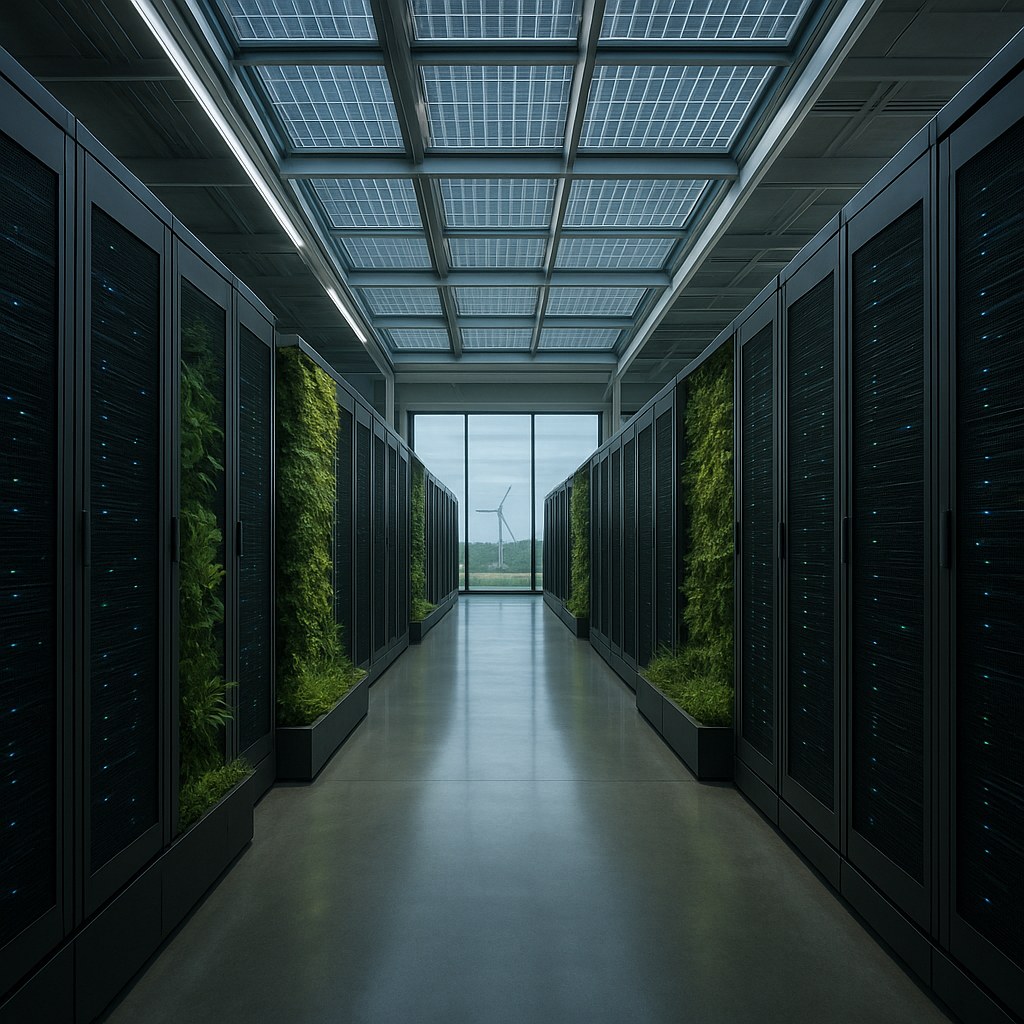
Data centres now consume roughly 1–1.5% of global electricity, and with the explosive growth of artificial intelligence, cloud computing, and streaming services, that figure is climbing fast. The International Energy Agency estimates that data centre electricity demand could double by 2026, reaching levels comparable to the entire energy consumption of Japan. For operators, engineers, and sustainability professionals, minimising the carbon footprint of modern data centres has shifted from a nice-to-have to an operational imperative.
The good news? The industry has proven that dramatic reductions are possible. Some hyperscale facilities now operate with power usage effectiveness (PUE) ratings below 1.2, and innovative cooling, workload management, and renewable energy strategies are pushing boundaries further. This article explores practical, evidence-based strategies for sustainable computing — from quick wins to long-term structural changes.
Understanding the Data Centre Carbon Footprint
Before tackling solutions, it helps to understand where emissions actually come from. A data centre’s carbon footprint spans two broad categories:
- Operational emissions — the electricity consumed by servers, cooling systems, networking equipment, and supporting infrastructure. This typically accounts for the largest share of lifetime emissions.
- Embodied carbon — the emissions generated during the manufacturing, transportation, and construction of servers, buildings, and components. Research suggests embodied carbon can represent 15–40% of a facility’s total lifecycle footprint.
Key metrics used to measure and benchmark performance include:
- PUE (Power Usage Effectiveness) — total facility energy divided by IT equipment energy. A PUE of 2.0 means half the energy goes to non-IT overhead. The global average hovers around 1.55–1.6, while best-in-class facilities achieve 1.1 or lower.
- CUE (Carbon Usage Effectiveness) — total CO₂ emissions divided by IT energy consumption, factoring in the carbon intensity of the local grid.
- WUE (Water Usage Effectiveness) — increasingly important as cooling systems consume vast quantities of water in many regions.
Tracking these metrics provides the baseline from which meaningful improvements can be measured.
1. Optimise Cooling Systems
Cooling typically accounts for 30–40% of a data centre’s total energy consumption, making it the single biggest target for efficiency gains after the IT load itself.
Free Cooling and Economisation
In temperate climates — including much of the UK and Northern Europe — outside air can be used to cool facilities for large portions of the year. Air-side and water-side economisers can reduce mechanical cooling requirements by 60–80%, dramatically cutting both energy use and costs.
Hot Aisle/Cold Aisle Containment
Separating hot exhaust air from cold intake air prevents mixing and allows cooling systems to operate far more efficiently. Containment strategies can improve cooling efficiency by 20–40% with relatively modest capital investment.
Liquid Cooling
As rack densities increase — particularly with AI workloads pushing 30–100kW per rack — traditional air cooling reaches its limits. Direct-to-chip liquid cooling and immersion cooling can reduce cooling energy by up to 90% compared to conventional approaches, whilst enabling heat reuse opportunities.
Raising Operating Temperatures
Many facilities still run colder than necessary. ASHRAE guidelines permit server inlet temperatures up to 27°C, yet plenty of data centres operate at 20°C or below. Each degree of temperature increase can yield 2–4% cooling energy savings.
2. Improve Server Utilisation and IT Efficiency
Here’s an uncomfortable truth: the average server utilisation rate in enterprise data centres sits between 10–20%. That means the vast majority of servers are consuming substantial power whilst doing very little useful work. An idle server still draws 30–60% of its peak power.
Virtualisation and Consolidation
Virtualisation allows multiple workloads to run on a single physical machine, dramatically improving utilisation rates. Consolidating workloads onto fewer, more efficient servers can reduce IT energy consumption by 50% or more in some environments.
Decommissioning Zombie Servers
Studies suggest that 20–30% of servers in typical enterprise data centres are “zombies” — powered on but performing no useful function. Identifying and decommissioning these machines is one of the most cost-effective carbon reduction strategies available, requiring no capital expenditure whatsoever.
Efficient Hardware Refresh Cycles
Newer server generations deliver significantly more compute per watt. Modern processors can offer 2–3x the performance per watt compared to models from five years ago. However, refresh decisions must balance operational savings against the embodied carbon of manufacturing new equipment — extending hardware life where performance allows is often the greener choice.
3. Transition to Renewable Energy
Even the most efficient data centre will carry a substantial carbon footprint if powered by fossil-heavy grid electricity. Energy sourcing is therefore critical.
Power Purchase Agreements (PPAs)
Long-term PPAs with wind and solar generators allow operators to fund new renewable capacity whilst securing stable electricity prices. Major operators like Google, Microsoft, and Amazon have become some of the world’s largest corporate purchasers of renewable energy through this mechanism.
On-Site Generation
Rooftop solar, whilst rarely sufficient to power an entire facility, can offset a meaningful portion of consumption. Some operators are also exploring hydrogen fuel cells and small modular nuclear reactors for future baseload clean power.
24/7 Carbon-Free Energy Matching
Simply purchasing annual renewable energy certificates doesn’t guarantee carbon-free operation around the clock — the sun doesn’t always shine and the wind doesn’t always blow. Leading operators are now pursuing hourly matching, ensuring that every hour of consumption is matched with carbon-free generation on the same grid. This represents the gold standard for renewable energy claims.
4. Embrace Intelligent Workload Management
Software-level optimisation offers substantial, often overlooked, carbon savings.
Carbon-Aware Computing
Grid carbon intensity varies dramatically by time of day and location. Carbon-aware scheduling shifts flexible workloads — such as batch processing, AI training, and backups — to times and regions where electricity is cleanest. Google’s implementation of this approach has demonstrated meaningful emissions reductions without any hardware changes.
Geographic Load Balancing
For organisations operating multiple facilities, routing workloads to regions with lower-carbon grids can reduce emissions significantly. The carbon intensity of electricity in Sweden or Norway, for instance, is a fraction of that in coal-dependent grids.
Efficient Code and Data Practices
Software efficiency matters more than many realise. Optimised algorithms, reduced data redundancy, efficient storage tiering, and deleting unnecessary data all contribute. The average enterprise stores enormous volumes of “dark data” — information collected but never used — consuming energy for no benefit.
5. Address Embodied Carbon and Circularity
Operational efficiency alone won’t deliver truly sustainable computing. The embodied carbon in hardware and construction demands attention.

- Extend equipment lifespans — running servers for five to seven years rather than three to four spreads manufacturing emissions across more useful work.
- Refurbished and remanufactured hardware — secondary market equipment can deliver 70–90% lower embodied carbon than new equivalents for suitable workloads.
- Responsible end-of-life management — proper recycling and materials recovery prevents e-waste and recovers valuable materials like gold, copper, and rare earth elements.
- Low-carbon construction — for new builds, materials choices matter enormously. Mass timber, low-carbon concrete, and recycled steel can cut construction emissions by 30–50%.
6. Reuse Waste Heat
Data centres convert virtually all consumed electricity into heat. Rather than treating this as a disposal problem, forward-thinking operators are capturing it as a resource.
In Scandinavia, several facilities feed waste heat into district heating networks, warming thousands of homes. Stockholm Data Parks aims to heat 10% of the city using recovered data centre heat. Elsewhere, waste heat warms greenhouses, swimming pools, and even supports agricultural drying processes. Liquid cooling systems, which produce higher-temperature output, make heat reuse considerably more practical than traditional air cooling.
7. Measure, Report, and Set Science-Based Targets
What gets measured gets managed. Robust measurement frameworks underpin every successful sustainability programme:
- Establish baselines using PUE, CUE, and WUE metrics
- Adopt recognised reporting frameworks such as the GHG Protocol, covering Scope 1, 2, and increasingly Scope 3 emissions
- Set science-based targets aligned with limiting warming to 1.5°C
- Consider certifications such as ISO 50001 (energy management) and ISO 14001 (environmental management)
- Report transparently — regulatory requirements like the EU’s Energy Efficiency Directive now mandate detailed data centre reporting
Frequently Asked Questions
How much carbon does a data centre produce?
It varies enormously based on size, efficiency, and energy source. A large hyperscale facility might consume 100–500 GWh annually. On a coal-heavy grid, that could mean hundreds of thousands of tonnes of CO₂; on a renewable-powered grid, operational emissions approach zero. Collectively, data centres are estimated to account for around 1–1.3% of global greenhouse gas emissions when electricity-related emissions are included.
What is a good PUE for a data centre?
The global average sits around 1.55–1.6. A PUE below 1.4 is generally considered good, whilst leading hyperscale facilities achieve 1.1–1.2. The theoretical minimum is 1.0, meaning every watt powers IT equipment directly.
Is cloud computing more sustainable than on-premises data centres?
Generally, yes. Hyperscale cloud providers typically operate far more efficient facilities with better utilisation rates and stronger renewable energy commitments. Studies suggest migrating workloads to the cloud can reduce associated carbon emissions by 60–90% compared to typical enterprise data centres — though actual results depend on the provider and region.
Can AI help reduce data centre emissions?
Ironically, yes — despite AI driving demand growth. Machine learning systems have been used to optimise cooling in real time; Google famously reduced cooling energy by up to 40% using DeepMind’s AI. AI can also optimise workload scheduling, predict equipment failures, and fine-tune power distribution. In fact, AI assistants improving productivity in other workplace contexts demonstrates how these same intelligent systems can be applied to sustainability challenges.
Conclusion
Minimising the carbon footprint of modern data centres requires a layered approach. Cooling optimisation and improved server utilisation deliver immediate efficiency gains. Renewable energy procurement — ideally with 24/7 carbon-free matching — addresses the emissions intensity of remaining consumption. Intelligent workload management, embodied carbon reduction, waste heat reuse, and rigorous measurement complete the picture.
None of these strategies exists in isolation. The facilities achieving the most impressive results combine multiple approaches, treating sustainability as a core design principle rather than an afterthought. As digital demand continues its relentless growth, the organisations that embed these practices now will be best positioned for a future where carbon performance is as scrutinised as uptime and cost. The technology and knowledge already exist — what remains is the commitment to deploy them at scale.
Leave a Reply