


Augmented reality has spent years lingering at the edge of mainstream consciousness — teased by Pokémon GO, trialled in warehouses, and hyped at every major tech conference since the early 2010s. Yet something has shifted recently. The hardware has matured, the software ecosystems have deepened, and the use cases have moved well beyond novelty. AR interfaces are no longer a question of whether — they are firmly a question of how fast and in what form.
This article takes a close look at where augmented reality interfaces currently stand, what the technology actually involves, and where credible trends suggest it is heading over the next several years.
What Makes an Augmented Reality Interface Different
Before diving into predictions and trends, it helps to be precise about what an AR interface actually is — because the term gets used loosely. Augmented reality overlays digital information onto the real physical world in real time. Unlike virtual reality, which replaces your environment entirely, AR keeps the physical world intact and adds a layer on top of it.
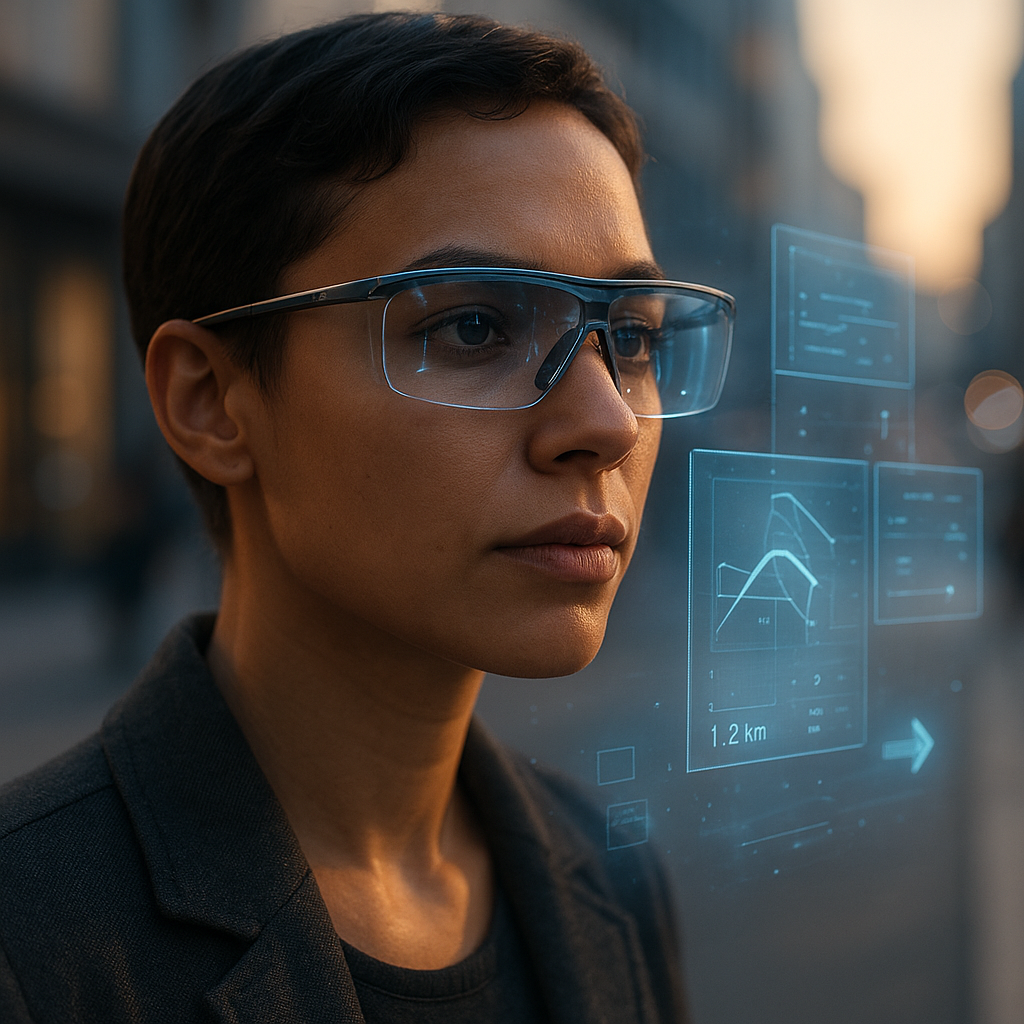
An AR interface, then, is any system that allows a human to interact with both the physical and digital layers simultaneously. That could be a heads-up display in a fighter jet, a smartphone held up to a restaurant menu, a pair of smart glasses that annotates the world as you walk through it, or a surgeon’s visor displaying a patient’s vitals during an operation.
The defining characteristics of AR interfaces include:
- Real-time rendering — digital elements must update as the physical environment changes
- Spatial anchoring — virtual objects need to appear fixed in physical space, not floating randomly
- Low latency — delays between physical movement and digital response cause disorientation and nausea
- Contextual awareness — the system must understand what it is looking at to display relevant information
- Natural interaction — users should be able to engage with digital overlays through gesture, gaze, voice, or touch
The Current State of AR Hardware
Hardware has historically been the bottleneck. Early AR headsets were bulky, expensive, and had narrow fields of view that felt more like peering through a letterbox than experiencing a genuinely augmented world. That picture is changing considerably.
Headsets and Smart Glasses
Microsoft’s HoloLens 2, Meta’s Quest line, and Apple’s Vision Pro have each pushed the envelope in different directions. The Vision Pro, in particular, demonstrated that consumer-grade spatial computing could achieve high fidelity — though its price point and form factor still place it in early-adopter territory. Meanwhile, lighter smart glasses from companies like Ray-Ban Meta have prioritised wearability over visual AR features, essentially functioning as audio-first devices with cameras attached.
According to IDC data, the AR and VR headset market shipped approximately 8.1 million units in 2023, with forecasts suggesting significant growth through the latter half of the decade as prices fall and form factors slim down.
Smartphone AR
For the vast majority of people globally, smartphones remain the primary AR interface. ARKit (Apple) and ARCore (Google) have given developers robust platforms to build AR experiences that work on devices already in billions of pockets. IKEA’s furniture placement app, Google’s AR walking directions, and Snapchat’s face filters are all everyday expressions of smartphone AR that most users engage with without thinking of them as “augmented reality” at all.
Heads-Up Displays
In automotive and aviation contexts, HUDs project critical information onto windscreens or visors. Modern vehicles from manufacturers including BMW, Mercedes-Benz, and various Chinese EV brands now offer AR-enhanced navigation overlays that project turn-by-turn directions directly onto the road ahead. This is arguably the most quietly mainstream form of AR currently in operation.
Where AR Interfaces Are Being Used Right Now
Understanding the future requires grounding in what is already working. AR has found genuine traction in several sectors.
Manufacturing and Industrial Operations
Factory floors have become one of the most compelling real-world testing grounds for AR. Workers equipped with AR headsets can see step-by-step assembly instructions overlaid directly onto machinery, reducing errors and training time significantly. Boeing has reported using AR-assisted wiring on aircraft, with initial studies suggesting substantial reductions in wiring errors and production time. SAP and PTC’s Vuforia platform have both built enterprise AR tooling that integrates with existing industrial systems.
Healthcare and Surgery
Medical applications represent some of the most high-stakes uses of AR. Surgeons can use AR overlays to view pre-operative imaging data — MRI scans, CT results — superimposed on a patient during a procedure. Companies like Medivis and Proprio have developed systems aimed at orthopaedic and spinal surgery. Beyond the operating theatre, AR is being used for anatomy education, physiotherapy guidance, and even vein visualisation to assist with difficult injections.
Retail and E-Commerce
The ability to “try before you buy” virtually has made AR increasingly valuable in retail contexts. Furniture, eyewear, cosmetics, and even clothing brands have integrated AR try-on features into their apps and websites. Snap’s research suggested that shoppers who engage with AR features are 94% more likely to convert than those who do not — a statistic that has accelerated investment in the sector.
Education and Training
From primary school science lessons to military training exercises, AR is reshaping how information is taught and retained. The ability to visualise abstract concepts — the solar system, human anatomy, historical architecture — in three dimensions anchored to real physical space offers pedagogical advantages that flat screens simply cannot match.
The Key Trends Shaping AR Interfaces in the Coming Years
Several converging forces are likely to define how AR interfaces evolve through the late 2020s and into the 2030s.
The Shift Toward Ambient and Persistent AR
Today’s AR experiences are largely session-based — you open an app, you see the overlay, you close the app. The next frontier is persistent AR, where digital objects and information remain anchored in physical space over time, visible to anyone with the appropriate device. Imagine leaving a digital note on a wall that your colleague can read with their glasses tomorrow, or seeing a historical building’s original façade reconstructed whenever you look at its ruins.
This requires what the industry calls “spatial maps” — persistent, shared 3D models of the world that cloud infrastructure can serve in real time. Companies like Niantic (with their Lightship platform) and Apple (with their spatial computing ecosystem) are investing heavily in exactly this kind of infrastructure.
AI Integration and Contextual Intelligence
The most transformative shift in AR interfaces may be the deep integration of large language models and computer vision AI. An AR interface that can identify what it is looking at — an object, a face, a piece of text in a foreign language — and respond intelligently is qualitatively different from one that merely renders pre-baked 3D assets.
Google Lens already demonstrates this on smartphones. The next generation of AR glasses could offer real-time translation, object identification, contextual recommendations, and conversational interaction with the physical environment. The combination of capable edge AI chips and cloud processing is making this increasingly feasible at consumer price points. AI innovations shaping the tech world are accelerating this integration across industries, with computer vision and large language models sitting at the heart of next-generation AR experiences.
Lighter, More Social Hardware
The social acceptability of AR hardware matters enormously. People are unlikely to wear devices that make them look conspicuous or uncomfortable. The industry’s trajectory is clearly toward lighter, more ordinary-looking glasses. Meta, Google (reportedly), and a cohort of startups are all working toward glasses that look indistinguishable from standard frames while housing cameras, microphones, small displays, and wireless connectivity.
This is a formidable engineering challenge — packing the necessary optics and processing into a small, lightweight form factor without overheating or draining a battery in an hour. However, advances in waveguide displays, micro-LED technology, and specialised AR chips are making incremental progress every product cycle.
Haptic and Multi-Sensory Feedback
Current AR interfaces are almost entirely visual and, to a lesser extent, auditory. Adding haptic feedback — a sense of touch when interacting with virtual objects — would dramatically increase the believability and utility of AR interactions. Research projects at institutions including MIT and Stanford have explored gloves and wristbands that simulate tactile sensations. Ultrahaptics (now Ultraleap) has demonstrated mid-air haptic feedback using ultrasound, which could be integrated into AR environments without requiring physical accessories.

The Role of 5G and Edge Computing
Sophisticated AR experiences demand enormous computational resources. Processing spatial maps, running real-time AI inference, rendering high-quality 3D content — all of this is too much for a lightweight wearable to handle locally. The solution lies in distributing computation across edge servers accessed via low-latency 5G connections. As 5G enhances digital experiences and edge computing deployments expand, the ceiling for what AR interfaces can do in the field rises considerably.
Privacy, Ethics, and Societal Implications
Any honest assessment of AR’s future must grapple with its implications beyond the technical. AR glasses equipped with cameras and AI are, by their nature, surveillance devices. The capacity to identify people by their faces in real time, record private conversations, or overlay misleading information into someone’s view raises serious ethical questions that regulation has not yet caught up with.
Facial recognition via AR is already technically feasible — researchers have demonstrated it using off-the-shelf hardware. Whether and how this capability gets embedded into consumer devices will depend on regulatory frameworks, public pressure, and the choices of platform developers. The European Union’s AI Act and emerging data protection legislation in multiple jurisdictions will shape these boundaries, but the technology is moving faster than the rules.
There are also questions around attention, cognitive load, and mental health. Constant information overlays could be as much a burden as a benefit, fragmenting attention and blurring the boundary between the digital and the physical in ways that are not yet well understood.
What the Next Decade Plausibly Looks Like
Drawing together the hardware trends, software developments, and infrastructure investments, a plausible trajectory for AR interfaces over the next decade looks roughly like this:
- By 2026–2027: Lightweight smart glasses with genuine optical AR displays become available at sub-£500 price points, driven by competition between Meta, Apple, Google, and Asian manufacturers.
- By 2028–2029: Persistent AR layers begin appearing in cities, shopping centres, and workplaces, initially opt-in and controlled by platform providers.
- By 2030+: AR interfaces become a standard component of professional environments — manufacturing, healthcare, logistics — with consumer adoption accelerating as hardware becomes as casual as earphones.
The pace of this transition will depend on how quickly the hardware miniaturisation problems are solved, how regulators respond to privacy concerns, and whether a truly killer consumer application emerges that drives mass adoption in the way that GPS navigation did for smartphones.
Conclusion
Augmented reality interfaces have moved from science fiction to working technology across multiple industries. The fundamentals — spatial anchoring, real-time rendering, contextual awareness — are now technically achievable, even if the hardware and infrastructure required to deliver them seamlessly at scale are still maturing.
The most significant developments ahead lie not in any single device but in the convergence of several trends: AI-driven contextual intelligence, persistent shared spatial maps, lighter and more socially acceptable hardware, and the edge computing infrastructure to support it all. Each of these is advancing independently and reinforcing the others.
What remains genuinely uncertain is the societal negotiation around privacy, attention, and the nature of shared reality that ambient AR will inevitably provoke. Technology rarely waits for those conversations to conclude before arriving. Understanding where AR interfaces are headed — technically and culturally — is increasingly relevant to anyone thinking seriously about the near-term digital landscape.
Leave a Reply